We’ve all played the cable-routing game: a power brick for the TV, an HDMI cord for the Apple TV, an eARC cable for the soundbar, and a rogue Ethernet wire just to keep it all online. It’s an unsightly web of copper and plastic, and we’ve simply accepted it as the cost of a modern living room. But a new standard called GPMI is making a radical promise: one single cable to rule them all. Imagine a setup where your TV doesn’t even have a power cord because a single sleek wire delivers 192 Gbps of data, gigabit internet, and 480 Watts of power all at once. It sounds like the ultimate consumer convenience—until you realize this cable wasn’t created to fix your cable clutter. It was built for geopolitical survival.
Introducing GPMI, or General Purpose Media Interface, developed by the Shenzhen 8K UHD Video Industry Collaboration Alliance (or by its simpler name: SUCA). Behind this alliance are some of the biggest tech vendors from the Far East, including Hisense, Sharp, TCL, Huawei and ZTE – in fact there are over 50 members. They have developed this cable to be the holy grail of connectivity, carrying up to 192 Gbps data, 480W power and mesh gigabit networking.
To put that in context for the techies amongst us, compared to Thunderbolt 5 (the highest performing spec available) from a data perspective its 60% faster, it can handle 2x the power and other than the traditional ethernet cable (which in all fairness can carry obscene speeds) it will mesh with up to 128 nodes at gigabit speeds.
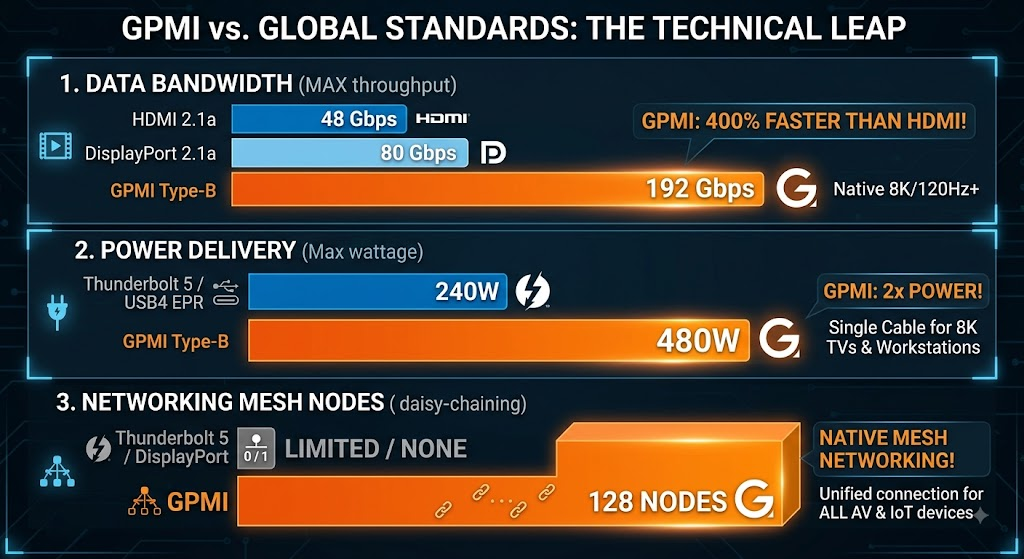
For the videophiles reading, it means 8k video at insane refresh rates (240Hz), enough power to power any TV currently on the market (an 85-inch would typically draw between 180W-300W) and the mesh networking would allow for 128 devices to be daisy-chained together, meaning they can share signals, internet data, multi-channel audio and power across TVs, monitors, speakers and streaming boxes. Imagine a day where you will just have 1 cable coming out the back of your TV and all your connected devices pull power and data straight from your tv! It’s all very impressive.
But the thing is, this isn’t built to impress you or me, its not made for a sleek consumer convenience upgrade, its a strategic move for IP independence and economic competition.
For those expecting me to begin ranting about US vs China, I’m a techie at heart – so naturally I’ll leave that to those experts. But the history of display and data cables is pretty crazy
- The Analog Era (1950s – 1990s)
- RF Coaxial & RCA Composite: Carried low-res analog signals with horrendous colour bleed
- SCART & S-Video: Regional European consolildation (SCART) and the splitting of brightness and luminance (S-Video)
- VGA & Component: VGA tok over PC monitors and Component (YPbPr) began pushing early HD resolution
- The Bridge to Digital (1999 – 2000s)
- DVI: Ended the analog-to-digital signal degradation of LCD screens
- HDMI & DisplayPort: HDMI took over the TV world with combined video & audio whilst DisplayPort dominated PC monitors with high refresh rates
- The Universal Connector Era (2010s – Present)
- Lightning Cable: Apple pioneered reversable connectors and MFi licensing, paving the way for locked-in accessory ecosystems
- USB-C & Thunderbolt: Brought video, high-speed data and power delivery (USB-PD) into a single, universal plug.
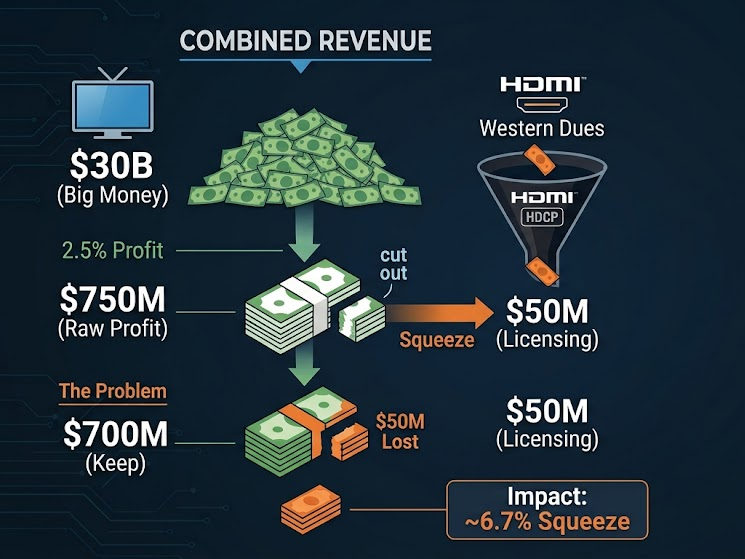
If we focus for a moment on Smart TVs, probably the most common display in households – a majority of those will be connected to streaming boxes via HDMI, whether that’s an Apple TV, an Amazon Firestick, or games consoles, PlayStation 5 or Nintendo Switch. But unbeknownst to the everyday consumer – every unit produced for the market is changed between $0.04 and $0.15 plus Digital Content Protection fees (HDCP) which is essentially an anti-piracy system created by Intel which is there stop users copying digital video and audio as it travels through cables.
But thats not the only cost, there are membership fees ($10k pa) and testing lab certifications that the manufacturers stump up, which cost upto $50k per model. If you do some rudimentary maths, a TV brand producing 20 million units a year could be spending up to $5m of that to US-based entities picking up these invoices.
It may not seem much, but from the members of SUCA across consumer TVs and monitors and commericial video walls, this is expected to be upwards of $50m per year, and they are still subject to the US holding the decryption keys for HDCP.
I know what most reading this will say, $50m is pocket change in comparison to what these companies annual revenues are. You’re right. It’s estimated that Hisense along generated around $8bn in revenue last year. Across the whole SUCA consortium, that $50m represents roughly 0.15-0.2% of their combined revenue. But the reality is different.
When it comes to consumer electronics, net profit margins hover between 1.5% – 3%, so if TVs generate $10bn in revenue, the net profit (after all expenses and overheads) could be only $150-$300m
If, like me, you’ve seen past the tech benefits, if you’ve seen past the financial benefits, you’ll be left with the obvious question in your mind: why are they really doing this?
I’m always one to give my opinion on here, and I would happily put a bet on this beginning when a majority of the West put sanctions on Huawei in late 2019/early 2020. This exposed China to their reliance of foreign software, chips and hardware standards.
Things escalated when the US put controls on semiconductor equipment making it harder for Chinese companies to source the hardware needed to build the latest hardware. The EU mandating USB-C showed Chinese regulators that state intervention in hardware standards works and put simply, it gives China the green light to build its own proprietary hardware standards at scale.
This, put simply, is a political battle in the world of tech. With the SUCA consortium not needing to use HDMI, they don’t need to use HDCP encryption (based on RSA, AES-128 and Blowfish), so they developed their own, the aptly named ADCP (Advanced Digital Content Protection) based on Chinese cryptographic standards (SM3/SM4) so foreign entities can never revoke decryption access.
As it stands, HDMI still dominates the display market, USB-C controls the global market but the introduction of GPMI gives us a glimpse into the future where the new battlegrounds lie. To take a rather philosophical look at this, in the 19th century controls was measured by railway lines, in the 20th century it shifted to oil pipelines and shipping lanes. In the 21st century, it could be measured by who owns the protocols running through the back of your smart tv.