
If there’s one thing my years in operational IT taught me, it’s that when security gets in the way of productivity, users will always find a workaround. Right now, Shadow AI is the ultimate example of that friction. Developers aren’t pasting proprietary code into LLM prompts to breach the company; they’re doing it at 2:00 AM because they just want to ship their sprint on time. Blocking AI entirely is an operational pipe dream, but letting it run blind is a disaster waiting to happen.
I’ve spent close to 20 years across more enterprise IT roles than I’d care to admit but one thing stood strong no matter what the latest ‘hot tech’ was. It was all about hardening the perimeter with the latest firewall, WatchGuard, Cisco, Checkpoint – we had them all. Then it was endpoint security (or AV software back in the day) – I remember vividly spending hours using Symantec, McAfee EPO – those are hours of my life I’ll never get back. The world of cybersecurity has changed a lot since then but many businesses haven’t realised there is a lot more than an endpoint solution and a firewall, Generative AI has changed the game. That encrypted prompt box, the one on Google Gemini, the one on ChatGPT or Claude, is your user’s opportunity to send raw text to cloud servers that you don’t control.
I know most of us glass-half-full folk would love to think that most of our users are using it simply to compare the latest tech, or to help write their bio for their online dating profile but the reality is most enterprises simply don’t know what their users are typing in.
Let’s frame that little prompt box a little differently – if you tear away all the marketing fluff its simply an outbound API payload – and if your security tools can’t read and evaluate that payload in real-time, you’ve got no control over that data.
Oh and by the way, it’s not just that GenAI prompt box either, its browser extensions, IDE auto-completers, PDF summarisers and SaaS integrations. We, as security professionals need to find a way of monitoring and controlling this Shadow AI in a frictionless manner, because when security gets in the way of productivity, users don’t stop working; they just find a quieter route around the fence.
The Binary Trap: Why Legacy Security Controls Fail
Many of you Security Architects, CISOs, Head of Cyber will turn round and say – we’ve got a Cloud-based Secure Web Gateway with SSL decryption, CASB products – but none of that matters… let me explain why.
Secure Web Gateway’s have their place in the security stack of course, but even with SSL decryption they’re taking a look at the URL, the destination IP, category or file hash when they’re inspecting. They then make a determination based on your rules to block or allow the site. If you decide to block the site, or the whole AI web-category then your users will switch to personal phones. If you allow it and trust that your users will follow the corporate policy you run the risk of source code, customer PII and financial data disappearing out of your network undetected.
CASB on the other hand will look at those files your users choose to upload. It will look at known file types (.xls or .pdf, etc) but it has no mechanism to evaluate a raw text block containing 500 lines of unreleased code or customer credit card numbers embedded in a prompt.
The Two Sides of the AI Risk Profile: Consumption vs. Creation
Understanding AI Risk isn’t that simple mainly because there are two sides to the story. There are those consuming those public LLMs and GenAI apps – the ChatGPTs of the world, and then there’s those internally created LLMs and apps. Both are a problem, but completely different risks. Let’s list those problems:
AI Consumption
(SaaS and Employees)
- Prompt Data Leaks
- Unvetted SaaS Apps
- Shadow AI Usage
AI Creation
(Custom LLMs & RAG)
- Prompt Injection
- Data Poisoning
- Toxic LLM Outputs
That consumption side is where convenience quietly turns into a compliance nightmare. When employees lean on unmonitored browser tools and third-party web apps to speed up their day, unstructured prompts become an invisible conveyor belt for data exfiltration—violating GDPR, HIPAA, or PCI-DSS before anyone in security even notices.
On the flip side, AI creation is where engineering teams start building custom apps and RAG pipelines that pull live data from external databases. The risks here shift firmly from human error to application-level vulnerabilities, exposing you to:
- Direct Prompt Injection: Users trick the model to bypass guardrails.
- Indirect Prompt Injection: AI reads untrusted external data with hidden commands.
- Data Poisoning: Tampered training data or an external data corruption.
- Toxic LLM Output: Model output triggers a code execution.
Modern AI Security: What “Good” Looks Like
Solving this double-sided threat vector requires moving past static perimeter proxies and adopting a modern inline security model. In practice, a resilient AI security framework relies on four core operational capabilities:
1. Continuous AI Discovery & Posture Management (AI-SPM)
You can’t secure what you don’t know exists. A modern architecture must automatically map the estate to identify every SaaS AI application in use, detect unmanaged API keys stored in dev environments, and catalog internal model endpoints spanning multi-cloud environments. AI-SPM bridges the gap left by CASB by providing deep visibility into how AI models, APIs, and data pipelines are configured and consumed across the enterprise.
2. Inline Contextual Guardrails & Real-Time Data Sanitization (AI Gateway)
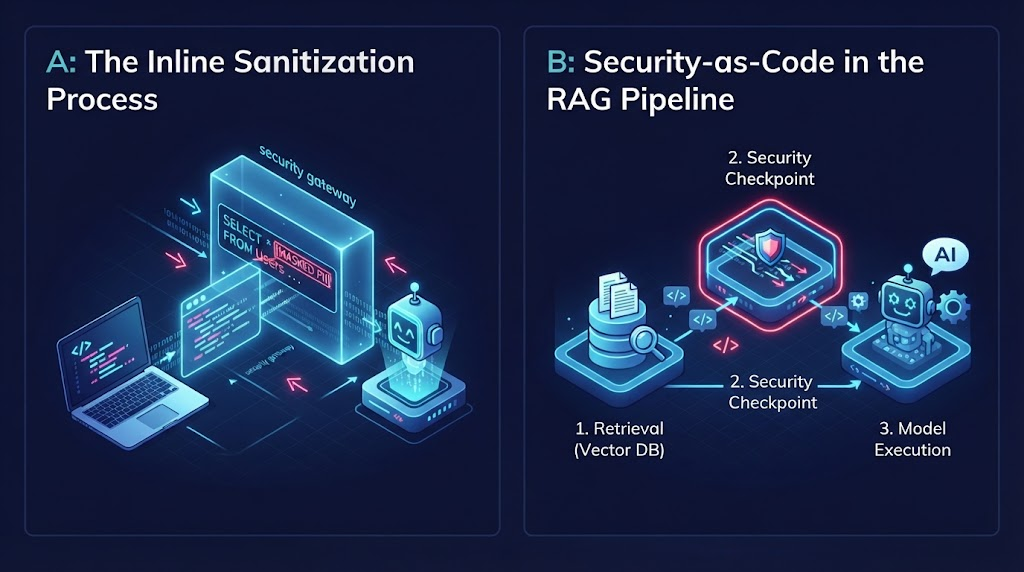
Rather than flat domain blocking, traffic inspection must happen at the payload layer in real time. Inline security inspects outgoing prompt text with millisecond latency—automatically detecting and masking PII, secrets, or proprietary source code before the request exits the network, allowing the employee to stay productive without compromising corporate IP – completely frictionless.
3. Security-as-Code for Custom Pipelines (Runtime Protection)
For teams building custom AI applications, guardrails must be programmatically embedded into the application lifecycle, not an afterthought. This is about dropping lightweight security hooks right in the middle of your RAG pipeline—nesting them between the UI, the vector DB, and the model itself so you can catch prompt injections on the way in and check the outputs before they go off and execute code downstream.
4. Automated AI Red-Teaming
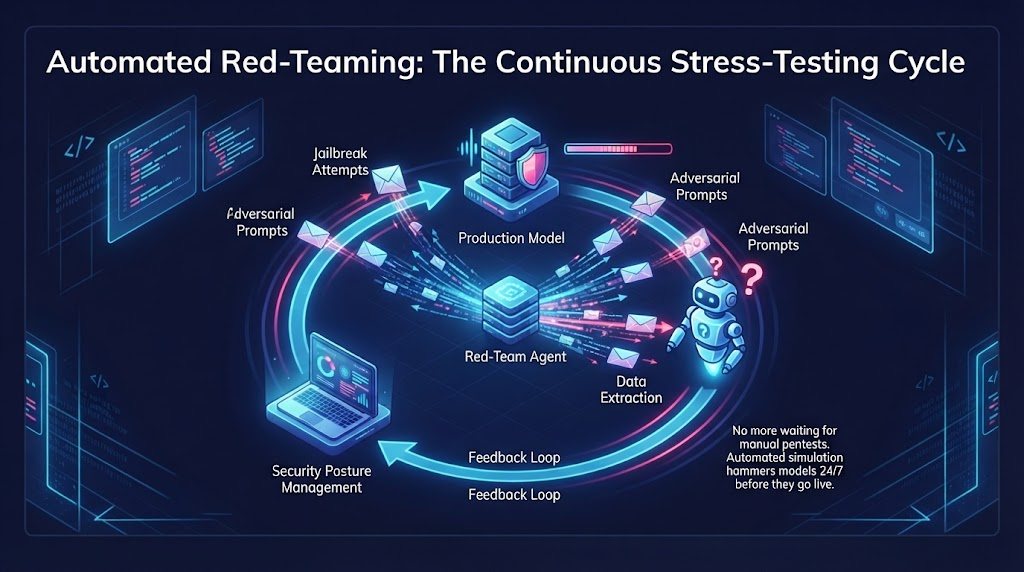
Manual pentests every six months just can’t keep up with how fast LLMs break. You’ve got to automate the red-teaming—constantly hammering your internal models with adversarial prompts, jailbreaks, and data poisoning attempts long before anything touches production.
Brakes Are Made for Speed
High-performance cars don’t have heavy-duty brakes so they can drive slowly—they have them so they can take sharp corners at speed without ending up in a hedge. Security guardrails play the exact same role in enterprise AI adoption.
Telling devs “don’t paste source code into ChatGPT” in a PDF policy document is completely useless when a sprint deadline is breathing down their neck. A policy without automated enforcement is just wishful thinking.
Trying to secure the AI era with yesterday’s network proxies leaves you with an ugly choice: strangle business velocity by locking everything down, or wait for a silent, massive data spill.
Don’t let your perimeter become a bottleneck. It’s time to trade the blunt instruments of the past for context-aware runtime security built for the speed of AI—because in modern tech, if your security slows down innovation, you’ve already lost.