
When foundation model invoices land, most teams face a massive bill with zero attribution. Shared API keys create financial blindspots, infinite dev loops, and major security risks. Learn how routing traffic through the Prisma AIRS AI Gateway combines active FinOps control—like virtual key attribution and semantic caching—with real-time threat protection in a single inline hop.
I’ve had one of those “spend a bit too much time on LinkedIn” weeks, and a specific pattern keeps showing up across my feed.
It always starts the same way: “First we experimented with LLMs, loved the results, and pushed them to production. Now we’re running agents at scale, and frankly, nobody knows who is spending what.”
A good friend was showing me his setup recently. He’s moved from spending eight hours a day typing out code in an IDE to orchestrating a swarm of autonomous agents while he acts as the reviewer. It’s an incredible jump in productivity—until he checked the usage tab. The token spend had gone completely rogue, driven by autonomous loops making hundreds of API calls in the background.
When the monthly model invoices land, most teams face massive figures with zero breakdown. But this isn’t just a billing headache; it’s an architectural flaw in how we hook applications into foundation models.
The Root Cause: Shared API Keys & Architectural Blindspots
In most engineering environments, AI integration starts with convenience. A developer generates an API key, drops it into a shared secret store or .env file, and points five different microservices at it.
It gets the job done on day one, but it breaks operational control down the line:
- Zero Cost Attribution: Provider dashboards bill per key. When ten microservices across three different feature teams share one key, parsing out who spent what on the monthly invoice is pure guesswork.
- No Protection Against Runaway Loops: A single misconfigured agent, a stuck batch job, or a recursive retry loop can burn thousands of pounds over a weekend before anyone notices.
- Compounded Security Exposure: Shared keys ignore basic least-privilege principles. If a key is exposed, revoking it breaks everything attached to it. Worse, direct API calls bypass payload inspection entirely, leaving systems open to prompt injection and accidental PII leaks.
A lot of the advice circulating online suggests setting up post-hoc dashboards or setting manual alert thresholds in provider consoles. Some even argue it’s “a finance problem, not an engineering problem.”
The issue with reactive dashboards is simple: they tell you what you spent yesterday, not what your runaway agent is spending right now. To fix token sprawl without slowing down developers, control has to live inline.
Moving to an Inline Control Plane
Solving token sprawl means moving away from direct, unmonitored model calls. Routing LLM traffic through a dedicated inline enforcement layer decouples your application code from raw provider credentials and shifts cost control from post-incident reporting to real-time execution.
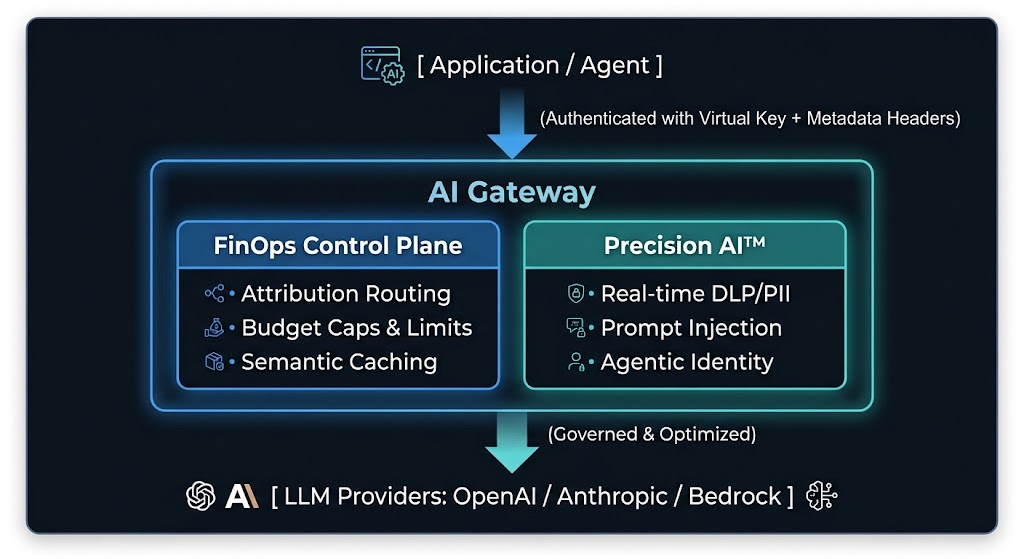
Instead of hand-wringing over a budget that got blown out by 400%, an inline architecture gives you direct controls:
- Virtual Keys & Scoped Context: Instead of handing out raw API credentials, teams use Virtual Keys tied to specific metadata (like team, environment, or cost center). You get granular breakdown down to the individual service without touching app code.
- Hard Budget Caps & Throttling: Rather than waiting for an email alert hours after a limit is breached, hard caps cut off runaway loops inline before a batch evaluation job drains your budget.
- Semantic Caching: A huge portion of enterprise LLM traffic consists of duplicate or near-identical prompts—internal documentation searches, regression runs, or standard system prompts. By evaluating prompts semantically at the gateway layer, identical requests receive cached responses in milliseconds, cutting token consumption to zero for those calls.
- Dynamic Model Routing: Not every prompt requires a massive frontier model. An inline layer can inspect request complexity and route simple text-formatting tasks to lighter, more cost-effective models, falling back to secondary providers automatically if an endpoint drops out.
Where Cost Control Meets Runtime Security
The most compelling argument for an inline gateway is that financial sprawl and security vulnerabilities stem from the exact same structural flaw: uninspected, direct traffic between your apps and the model providers.
When you solve the proxy problem for FinOps, you automatically solve it for SecOps. They are two disciplines inspecting the exact same stream of data on the exact same packet hop:
- Data Loss Prevention (DLP) & Cost Leakage: Preventing a developer from accidentally sending raw customer PII or proprietary source code to a public endpoint uses the exact same inspection engine that evaluates prompt token size and strips unnecessary context before it hits a paid API.
- Prompt Injection as a Denial-of-Wallet Attack: Prompt injection isn’t just about tricking an LLM into revealing secrets—it’s frequently used to force models into generating massive, recursive text responses that consume maximum tokens. Blocking malicious payloads at the perimeter stops security exploits and financial drain simultaneously.
- Agentic Boundaries: As we move from simple completion prompts to autonomous agents calling external APIs, security controls need to enforce what tools an agent can invoke. That exact same policy engine ensures an agent doesn’t get caught in an unthrottled loop calling high-cost toolchains repeatedly.
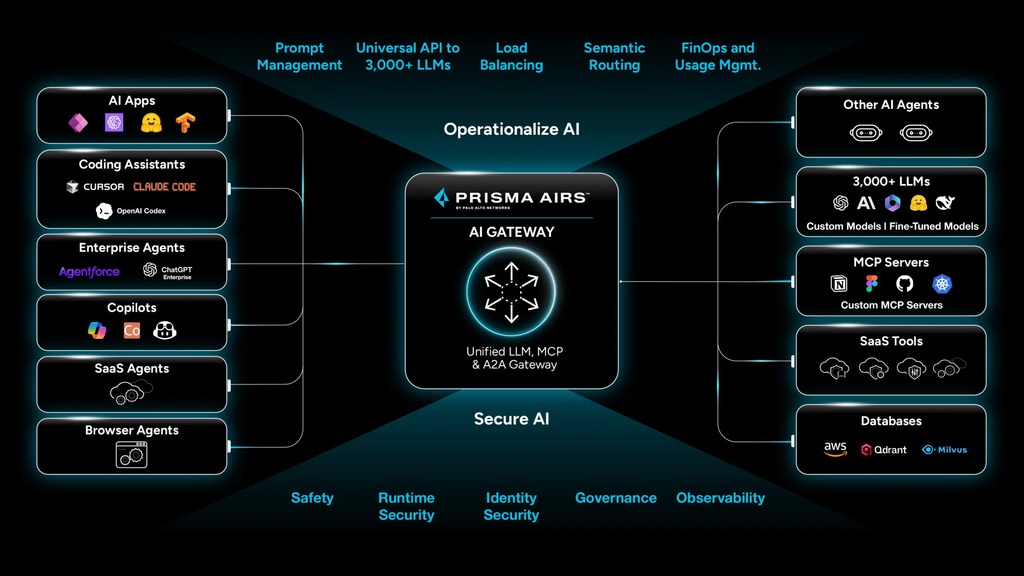
Security and FinOps Must Share the Same Control Plane
Security and FinOps shouldn’t operate in silos with different tools, double proxy hops, or conflicting priorities. By converging runtime protection and spend governance onto a single inline control plane, engineering teams get the freedom to build with AI fast, while the enterprise gets the real-time guardrails required to keep it secure and affordable.
This is why I believe Palo Alto Networks has got it right with the Prisma AIRS AI Gateway.
Rather than layering bolt-on dashboards after the fact or running separate security proxies alongside traditional API management gateways, Prisma AIRS sits directly inline just as the core Cloud Delivery Security do for web traffic.
Rather than forcing you to stitch together separate tools—or worse, bolt on post-hoc finance dashboards alongside a dedicated security proxy—Prisma AIRS handles the entire problem right at the network hop. It lets security block bad prompts, stop data leaks, and manage agent permissions, while finance gets clear usage attribution, hard spend limits, and caching to keep token costs under control.