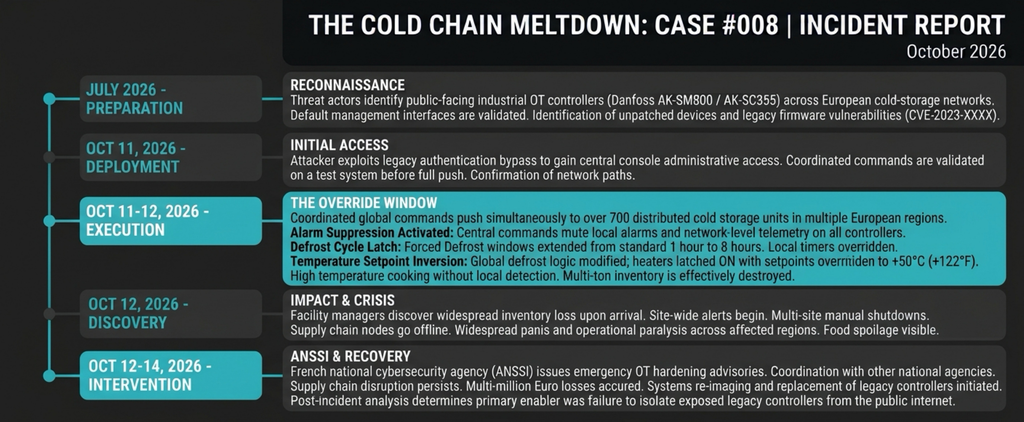
Target: European Cold-Storage Logistics & Retail Supply Chains (Distribution Hubs & Hypermarkets)
Date: October 2026
Threat Actor: Pro-Disruption Industrial Threat Group / Hacktivist Collective
Attack Vector: Exploitation of Exposed Legacy OT Controllers (Danfoss AK-SM800 / AK-SC355) & Unauthenticated Management Interfaces
Impact: Remote Manipulation of Physical Temperature Setpoints (+50°C), Mass Food Spoilage, and Multi-Million Euro Operational Losses Across Regional Supply Nodes
THE CRACK
Operational Technology (OT) and Building Management Systems (BMS) are vital for remote environmental monitoring and energy efficiency. However, leaving legacy controllers directly exposed to the internet with unpatched, well-documented vulnerabilities and default administrative interfaces creates a massive security blind spot.
In this campaign, threat actors didn’t need to craft zero-day exploits—they simply leveraged unpatched authentication flaws and direct web access on Danfoss refrigeration units that had reached End-of-Life (EOL) or were running unpatched legacy firmware.
THE EXECUTION
- Targeted OT Reconnaissance: Threat actors scanned public IPv4 ranges and industrial search engines to identify internet-facing Danfoss refrigeration management controllers—specifically legacy AK-SC355, EOL AK-SM800, and unpatched AK-SM800A series—across European distribution hubs and hypermarket networks.
- Exploiting Legacy Flaws & Default Access: Rather than using zero-day tools, attackers executed publicly available exploits targeting well-known vulnerabilities disclosed in previous years alongside unauthenticated web interfaces to bypass access controls and execute commands.
- Centralised Platform Access & Mass Payload: Armed with administrative access to central management consoles, the attackers reached across multiple regional storage facilities simultaneously rather than compromising sites piecemeal.
- Coordinated Alarm Suppression & Thermal Overrides: Through the centralised interface, the attackers pushed coordinated parameter overrides across hundreds of controllers: they systematically disabled local alarm thresholds, extended forced defrost windows from 1 hour to 8 hours, and increased the defrost termination temperature setpoints. By overriding the global defrost logic, electric resistance heating elements were continuously latched to maximum output (+50°C / 122°F), treating the extreme heat as a standard maintenance cycle—muting acoustic, visual, and network-level telemetry while cold storage units cooked overnight.
- Widespread Operational Chaos: Without dropping ransomware payloads or exfiltrating enterprise databases, the physical destruction of fresh and frozen inventory forced distribution nodes to halt shipping, discard stock, and take compromised systems offline.
THE BLAST RADIUS
- Massive Inventory Loss: Regional distribution hubs and major supermarket outlets across France and neighboring regions suffered immediate product loss, with damage estimates reaching tens of millions of euros across roughly 700 facilities.
- Preventable Supply Chain Failure: The exposure highlighted systemic patch management delays and missing basic security hygiene in OT environments, proving that ignoring well-known CVEs on legacy equipment carries severe real-world operational consequences.
- Physical Safety & Fire Hazards: Continuously powered electrical defrost resistance heaters and overheating compressor units created localized fire risks across affected distribution centres.
- Critical Infrastructure Impact: Essential food supply chain operations were disrupted, forcing national cyber security agencies (including France’s ANSSI) to intervene and issue emergency OT hardening advisories.
THE HARDENING PLAN
- Prioritise Patch Management & Lifecycle Audits for Exposed OT: Treat public-facing OT and BMS hardware with the same patching urgency as enterprise firewalls. Immediately inventory and replace end-of-life (EOL) units that can no longer receive vendor security updates.
- Isolate & Air-Gap BMS/OT Infrastructure: Audit site environments for forgotten 4G/5G cellular modems or direct ISP links attached to legacy OT equipment. Never allow building management systems or industrial regulators to sit directly on public-facing IP addresses. Enforce strict network segmentation, placing OT management interfaces behind zero-trust network access (ZTNA) or encrypted VPN tunnels with multi-factor authentication (MFA).
- Out-of-Band Hardware Safety Controls: Critical physical infrastructure (like food preservation or industrial HVAC) should never rely exclusively on software setpoints. Deploy hardwired, analog thermal cut-offs and independent out-of-band monitoring systems to automatically kill heater contactor power if temperature parameters exceed safe operational limits.
TIMELINE