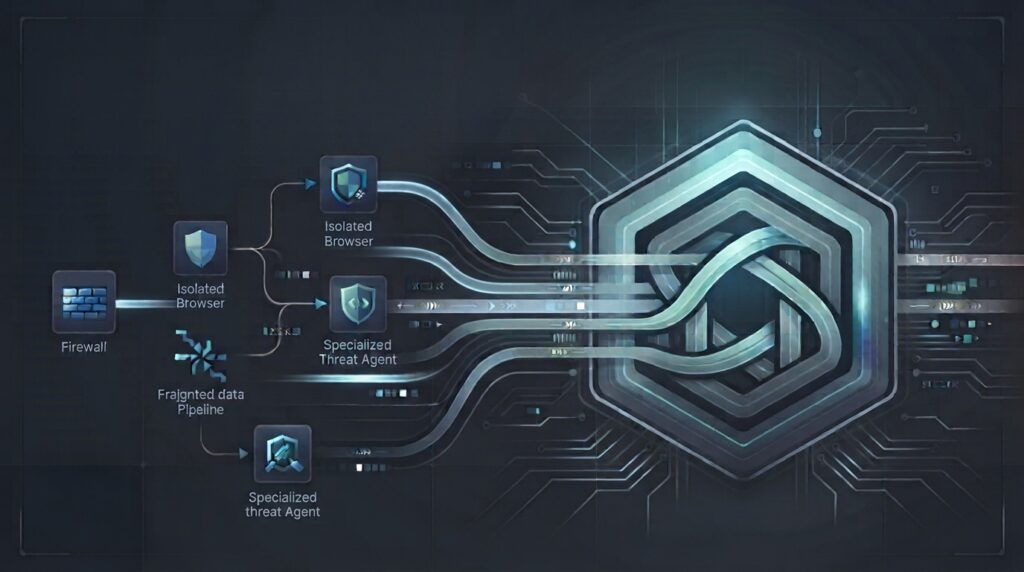
For years, the cybersecurity playbook was simple: spot a gap, launch a venture-backed startup, and build a hyper-specialized point solution. For enterprise architects and CISOs, however, the cumulative tax of that fragmentation has reached a tipping point. Managing dozens of siloed dashboards, disparate data pipelines, and custom API integrations creates severe operational friction.
The market has shifted decisively. Rather than collecting standalone tools, the industry is experiencing an aggressive, platform-driven consolidation wave.
I’ve recently become a bit obsessed (in a completely normal way – honest!) with trying to predict the next move of the behemouths of the security world. Trying to spot the patterns of risk ahead of the bad guys exploiting them at scale is no mean feat – and it’s so interesting watching not only the speed of acqusition but the speed of integration too.
I thought it would be good to take a look across the last 36-month window to reveal how hyperscalers and platform giants have accelerated this land grab, absorbing category-defining technology to lock down the enterprise stack—including modern control points like enterprise browsers, AI gateways, and next-gen firewalls.
market snapshot: the last 36 months
| Metric / Indicator | Industry Baseline / Trend | Architectural Impact |
| Global Deal Volume | ~400 to 500+ disclosed M&A transactions annually | Tool sprawl is forcing a structural clean-up; point solutions are rapidly being absorbed into platform suites. |
| Pure-Play Deal Value | Scaled from ~$28B to ~$84B+ highs | Capital is heavily concentrated at the top as buyers pay massive, platform-defining premiums for category leaders. |
| Mega-Deal Concentration | Multiple transactions exceeding $10B+ (e.g., Google/Wiz, PANW/CyberArk) | Hyperscalers and platform titans are rewriting architecture standards by buying entire control planes natively. |
Major Acquisitions (Past 36 Months)
To understand the strategic direction of the major players, looking at multiple examples across key technology domains over the last three years highlights how large vendors are reinforcing specific architectural layers of their stacks—expanding well past traditional endpoints into browsers, AI traffic management, and network layers.
| Product / Technology Area | Target Company | Acquirer | Strategic Fit & Role in the Acquirer’s Stack |
| Enterprise Browsers | Talon Cyber Security | Palo Alto Networks | Secure Edge Control: Embedded natively into Prisma SASE/Access to govern unmanaged devices and stop browser-based data exfiltration. |
| Seraphic Security | CrowdStrike | Endpoint-Adjacent Defense: Adds enterprise browser isolation and protection capabilities across existing browsers via lightweight endpoint agents. | |
| AI Gateways & Governance | Portkey | Palo Alto Networks | LLM Traffic Control Plane: Acts as the central gateway for Prisma AIRS, routing and securing multi-model interactions and autonomous agentic workflows. |
| Prompt Security | SentinelOne | Runtime Guardrails: Intercepts shadow AI usage and blocks prompt injections, data leaks, and unauthorized tool calls at the inference layer. | |
| Identity & Non-Human Access | CyberArk | Palo Alto Networks | Identity Control Plane: Fuses enterprise IAM and privileged access management directly into core Strata and Cortex platforms to secure human, machine, and agentic workflows. |
| SGNL | CrowdStrike | Context-Aware Access: Adapts access dynamically based on real-time risk, supporting human, non-human, and AI agent identities in the Falcon platform. | |
| Oasis Security | Cyera | Non-Human Governance: Unifies data security posture management (DSPM) with automated tracking of machine identities, service accounts, and API/AI tokens. | |
| Permiso Security | Okta | Identity Threat Detection (ITDR): Expands continuous threat detection deeper into cloud environments and autonomous machine identities. | |
| Cloud-Native & Posture Management | Wiz | Google Cloud | Multi-Cloud Dominance: Anchors multi-cloud risk, vulnerability, and posture engines directly into Google’s threat intelligence and operations ecosystem. |
| XM Cyber (IP & Source Code) | CrowdStrike | Continuous Exposure Management: Bakes automated attack-path analysis natively into endpoint and cloud telemetry workflows. | |
| Telemetry & Observability | Chronosphere | Palo Alto Networks | AI-Era Data Scaling: Injects cloud-native observability directly into the security stack to handle massive telemetry volumes required by AI automation. |
The Architectural Dilemma: Monolith vs. Integration
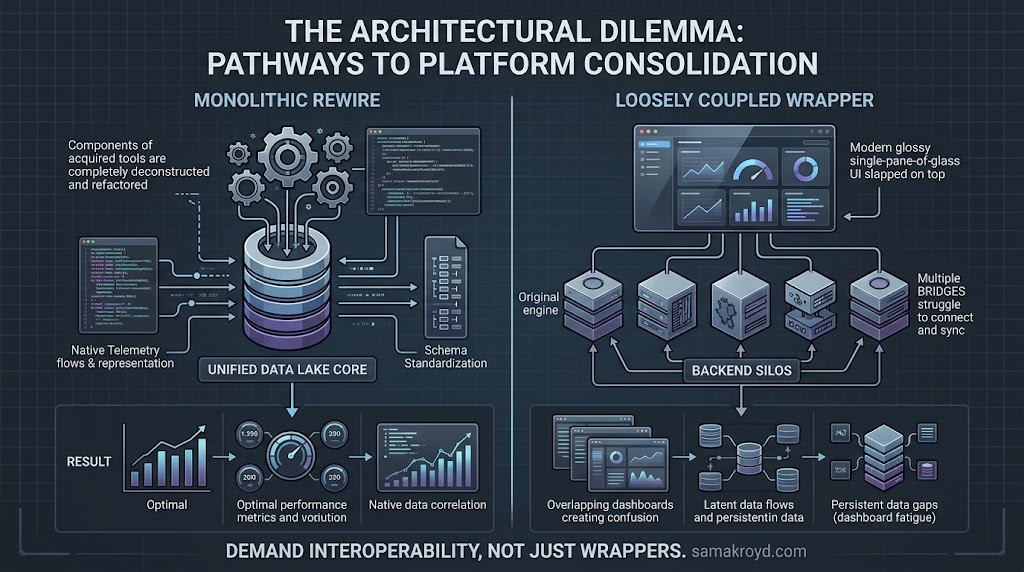
When a multi-billion-dollar vendor rolls up an acquisition—whether it’s an enterprise browser, an AI proxy gateway, or a core cloud posture engine—marketing teams promise instant, seamless integration. The engineering reality involves navigating two distinct integration patterns:
- The Monolithic Rewire: Deeply refactoring and rewriting the acquired product’s codebase natively into the platform’s core data lake.
- Pros: Optimal performance, unified schema, native telemetry correlation.
- Cons: High engineering complexity, extended delivery timelines.
- The Loosely Coupled Wrapper: Slapping a unified single-pane-of-glass UI over separate back-end engines while syncing data via APIs in the background.
- Pros: Rapid go-to-market.
- Cons: Persistent latency gaps, data silos, and “dashboard fatigue” disguised beneath a fresh coat of paint.
Conclusion
The 36-month M&A arc proves that scale and consolidation are the organizing principles of modern enterprise security. As platforms expand past firewalls and endpoints into emergent perimeters like enterprise browsers and AI traffic gateways, enterprise architects must look past the surface-level marketing wrapper.
The goal shouldn’t be blind faith in a single vendor logo, but demanding open APIs, data interoperability, and architectures capable of absorbing whatever technical shift comes next.