
Remember when an SSL/TLS certificate was treated like a legal contract or a physical asset? Back in the wild west of the internet, you could purchase a multi-year certificate—sometimes valid for up to three or five years—install it on a server, and file it away until it became a distant memory.
Those days are gone.
Over the last decade, the industry has systematically compressed maximum certificate lifespans. What used to be a low-frequency, “set-and-forget” annual administrative chore is rapidly transforming into an ephemeral, high-cadence operational workflow. And as we stare down the barrel of even shorter lifespans, organisations are realising a hard truth: managing certificates is no longer an administrative checklist task. It’s a core architectural and engineering challenge.
A Trip Down Memory Lane: The Shrinking Timeline
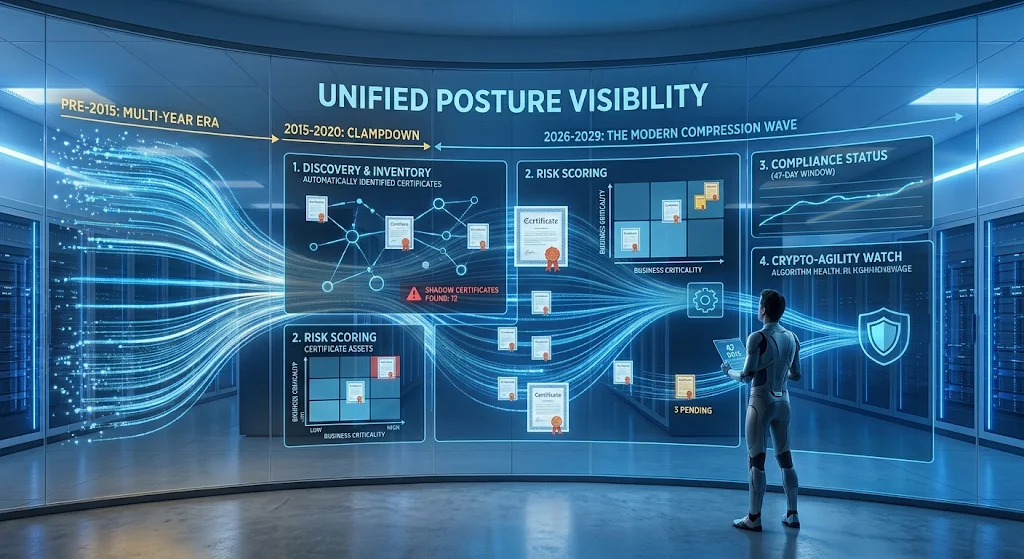
To understand where we are heading, it helps to look at how browser giants and the CA/Browser Forum systematically squeezed the timeline to enforce better cryptographic hygiene:
- The Multi-Year Era (Pre-2015): Lifespans up to 5 years meant credentials lingered long after administrators left, applications were decommissioned, or cryptographic standards evolved.
- The Clampdown (2015–2020): Lifespans dropped sequentially from 3 years to 825 days, and eventually hit a 398-day maximum standard backed by major browser operators in 2020. Multi-year certificates were officially dead.
- The Modern Compression Wave (2026–2029): The goalposts are shifting again with an aggressive multi-step descent:
- March 2026: Maximum validity drops to 200 days.
- March 2027: Lifespans shrink further to 100 days.
- March 2029: The floor drops to just 47 days, accompanied by compressed Domain Control Validation (DCV) reuse windows.
Why the Industry is Being Forced Here
This acceleration isn’t just about moving fast for the sake of it; it addresses critical systemic vulnerabilities in modern IT landscapes:
- The Narrowing Blast Radius of Compromise: If a private key leaks, a multi-year certificate gives an adversary a massive window to stage man-in-the-middle attacks or decrypt archived traffic. Shortening lifespans drastically shrinks that operational runway.
- Crypto-Agility and Post-Quantum Readiness: Migrating enterprise architectures to post-quantum algorithms isn’t a single “rip-and-replace” event. Short lifespans build the muscle memory and automated pipelines necessary for rapid cryptographic transitions.
- Eliminating Orphaned Assets: Stale, forgotten certificates left on abandoned cloud buckets, shadow IT workloads, or legacy appliances are goldmines for threat actors. Frequent re-validation forces continuous verification of asset ownership.
The Enterprise Reality: Security Intent vs. Operational Friction
While the security logic is sound, the operational reality for enterprise teams is brutal. When lifespans drop to weeks rather than years, relying on manual spreadsheets, calendar reminders, and ad-hoc renewal tickets is a recipe for catastrophic outages.
The friction usually stems from two areas:
- The Scale Problem: Multiplying certificate rotation frequency across hundreds or thousands of internal and external endpoints creates a compounding operational tax that can easily overwhelm engineering teams.
- The “Special Snowflake” Problem: Public-facing web servers handle standard ACME protocols easily, but internal PKI, legacy network appliances, OT/IoT gateways, and third-party integrations often stubbornly resist basic automation.

Moving from Reactive Scrambling to Continuous Trust Visibility
Surviving this continuous compression cycle requires a fundamental shift in how security and infrastructure teams approach public-key infrastructure. You cannot out-hire or out-process 47-day lifecycles.
To stay ahead of the curve, modern security architectures demand a few foundational capabilities:
- Comprehensive Discovery and Inventory: You cannot secure or renew what you don’t know exists. Organisations need continuous, automated discovery mechanisms that scan internal networks, cloud environments, and perimeter infrastructure to surface hidden or shadow certificates before they trigger an outage.
- Risk Scoring and Prioritisation: Not all certificate expirations carry the same weight. Intelligent platforms must automatically contextualise assets—distinguishing between a low-risk internal test page and a critical customer-facing gateway—so teams can prioritise remediation effectively.
- Unified Posture Visibility: Siloed certificate management creates blind spots. Bringing public certificates, internal CAs, and third-party assets into a single pane of glass allows teams to track compliance, spot weak cryptographic algorithms, and monitor expiration timelines proactively.
The Bottom Line
The countdown to sub-50-day certificate lifespans has already begun. Organisations treating this as a distant compliance hurdle will find themselves trapped in a perpetual cycle of firefighting and self-inflicted outages. By embracing automated discovery, deep cryptographic visibility, and robust lifecycle management tools today, you turn an operational headache into a baseline strength of your security posture.